|
|

|
|

|
|
|
|
Blazoning may be regarded as the art of describing in appropriate terms the charges according to their several gestures, positions, and tinctures. In blazoning there are rules, established by ancient custom, which must be observed: - This "How to Blazon" Learning Center feature may not be reproduced in any way without the expressed written permission of Armorial Gold Heraldry Services. Copyright © Armorial Gold Heraldry Services Thank You for your cooperation AG Team |
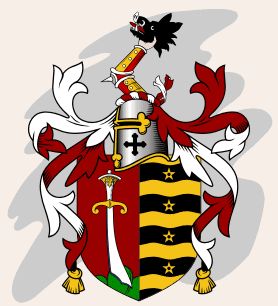
|
|
|
THE ART OF BLAZONING Blazoning may be regarded as the art of describing in appropriate terms the charges according to their several gestures, positions, and tinctures. In blazoning the following rules, established by ancient custom, must be observed: - 1. The description must be clear and in proper terms, nothing omitted which ought to be specified, and nothing specified which may safely be omitted. 2. The Field must be first specified. 3. If the Field be divided whether, per Pale, per Bend, per Fesse, or otherwise, the division should be mentioned first, with the difference of lines, whether indented, engrailed, or otherwise. 4. If the Field be undivided, that is, if it be not divided per Pale, per Bend, per Fesse, or Quarterly or Quartered or the like, the tincture of the Field is first to be dealt with, then the Ordinaries, and then the principal charges, primarily specifying those which occupy the most honourable place in the Shield, and mainly that charge first which lies next and immediately upon the Field and nearest the centre and then those charges which are more remote. But where a charge possesses the middle or centre of the Field, the Honourable Ordinaries, such as the Chief, Bordure, Orle Tressure, Quarter, and Canton are named after those other figures, because frequently the Chief, Bordure, etc., are either Differences or Augmentations. Thus we say, Or, a lion Azure, a Chief Gules. In blazoning a Coat of Arms in which different Quarterings are arranged in one Shield, the number should be specified, as quarterly of ten, twenty, or fifty, or any other number. 5. When a Lion or other principal bearing is placed both on the Chief and on the Field, the Chief must be mentioned after the Field of which it is a part; as for instance Argent, a Chief Azure, a Lion Gules, crowned and armed Or. 6. When the Shield is filled with many small Pales of Metal and Colour of an uneven number, as for example of five pieces Or and four Gules, then the greater number of pieces makes the Field and the lesser the charges; but when the pieces of Metal and Colour are equal or even it is called Paly at the same time expressing the number.
7. When the Shield is filled with an even number of Bends of Metal and Colour, not exceeding six it is called Bendy, but if the number extends to ten, then it is called Cotised, specifying the number of pieces. When the number of pieces in the Shield is uneven and exceeds nine, as for example 11 or 13, then the lesser number which makes the charges are called Ribbons containing a half part of the Cotise or Cost only. 8. After naming the tincture of the field, the Honourable Ordinaries or other principal figures, their attributes must be specified, that is whether they be indented, engrailed, wavy, etc., and afterwards their metal and colour. But if they be plain the bare mention of them with their tincture is sufficient. 9. When an Honourable Ordinary or some figure is placed upon another, whether it is a Fesse, Cheveron, Cross, etc., it is always to be named after the Ordinary or Figure over which it is placed, with one of these expressions, overall or surtout or surmounted by. 10. When a common charge is in the centre of the Shield, its position is not to be expressed, or what amounts to the same thing, when such a Bearing is named, without specifying the point where it is placed, then it is understood to occupy the middle of the Shield. But when a sword, a pair of wings, a trefoil, a lion , or any other figure or charge is placed in the manner of a Bend, a Pale, or Fesse, or other Ordinary, the figure or charge is said to be in Bend, in Pale, in Bend Sinister, in Fesse, etc. 11. A repetition of the same words must be avoided and especially such words as of, or and, with. Thus to blazon Azure, a Chevron Or, between three garbs Or, would be incorrect, but the coat might either be blazoned Azure, a Chevron between three Garbs Or, which implies that the Chevron and Garbs are Or; or Azure, a Chevron Or between three Garbs of the last, which would be equally correct. 12. As a rule metal must not be placed upon metal, or colour upon colour, and to do so is termed false Heraldry. 13. As to Ermine, when the spots are many and dispersed all over the Field, they are not to be numbered in the blazon of the Coat; but if a certain number be formally disposed, then the bearing is not to be blazoned Ermine, the spots being charges and called Ermine spots or Musketours; and in blazon their name, number, and position must be expressed. If a Cross, Saltier etc., composed of Ermine spots from a Coat, then the number should be mentioned, as Argent, 5 Ermine spots in cross or Saltier; Argent, 10 Ermine spots, 4, 3 2, and 1. 14. In blazoning of charges, whether animate or inanimate, if they are of the natural and proper colours of the creatures or things they represent, they must be termed proper, and not Argent, Gules, or such like. 15. The number of the points of Mullets and the rays of Estoiles or Stars must be specified when more than five; and also if a Mullet or any other charge be pierced the fact must be mentioned. 16. When Subordinate Ordinaries or common charges, such as Piles, Rays of the Sun, etc., are born in any other part of the Field than the centre, the point they are issuing from must be named. Where several bearings of the same species by their position seem to form one of the Ordinaries, in such a case, without regarding the points of the Shield, they must be blazoned by the name of the Ordinaries they represent, and one must say, for instance, five foxes in Bend, three lions in Pale, five bezants in Saltier, and so of others. Note there is a difference between Bearings in Chief and Ranged in Chief: one or more Bearings in Chief is said to express their position in the chief point of the Shield; but when, for instance, we say, three Torteauxes ranged in Chief, we mean, placed in a straight line, in form of a Chief. 17. If a Coat of Arms having a border be impaled with another, as by marriage, the border is wholly omitted on the side of the Shield parted per Pale which contains the Arms to which the border does not appertain; but if a Coat encompassed with a border is marshalled Quarterly with other Coats, then no part of the border must be omitted. 18. When there are many figures of the same kind born in a Coat of Arms, their number, position, and disposition must be observed and distinctly expressed. 19. When the Field is strewed with the same figures, some whole, others half seen, this is expressed by the word semé, or if the figures strewed on the Shield are entirely whole ones the expression may be varied to sans nombre. 20. When an Ordinary surmounts or is placed over an animal, it is said to be debruised or oppressed by that Ordinary. Should however the Ordinary lie over another Ordinary the expression "debruised by" must not be used, but the words "surmounted by," or "over all" employed. See Rule 9. It should be remembered that in Heraldry the word over invariably means upon, and is never used in the sense of above. 21. Charges are always to be represented as moving towards the Dexter side of the Shield unless otherwise specified. 22. The Fret is generally made up of six sticks and if there be more it must be mentioned. 23. The Treillis or Treillé is made up of eight sticks which is not to be expressed, but in blazoning of them the tincture of the nails which distinguish them from the Fret and Fretty should be specified. 24. In blazoning of heavenly bodies, such as the sun, moon, and planets, first the state or condition must be stated as to the sun whether in his meridian or eclipse; as to the moon whether in her increase or decrease, etc., and in general proper astronomical terms should be employed. 25. When man or the parts of his body are to be blazoned, it is first to be considered whether he is born whole or in part; if whole in what kind of gesture or action, also whether naked or clothed, and if the latter after what manner, as whether in armour, in robes, or in what costume. If the head only, whether whole front face, in profile, or in what aspect. When the temples of a man or woman are encircled with laurel, oak, ivy, etc., this has to be termed wreathed with laurel, oak, or ivy as the case may be. 26. The natural position of animals and other charges is not expressed in blazoning. Thus lions are naturally rampant, owls are always born full-faced, and ostrich feathers are with their tops embowed or turned down (to distinguish them from the feathers of other birds which are always born straight) which is not to be specified. Note that a plume of feathers is generally made up of three ostrich feathers which is not to be expressed, but if there be more, this must be mentioned. 27. The teeth, claws or talons of lions, tigers, bears, leopards, boars, wolves, dragons, and all ravenous beasts are called their arms, because they are weapons of offence and defence, so when they are of a different tincture from their bodies then the colour must be named; and when their tongues are of the colour of their arms, then they are said to be langued, as a lion Argent, armed and langued Gules. The claws and tongue of a lion are always Gules, unless the Field or Charge be Gules, when they must be Azure unless otherwise expressed in the grant of Arms. 28. If an animal is said to be dismembered, the parts are to be put a little distance from each other, but near enough to preserve the form and shape of the animal, which if dismembered in any particular part this should be mentioned, as dismembered on the head, if the head be cut off; dismembered of the right or left foot, or of his tail as the case may be. 29. A lion rampant without tongue and claws is sometimes called a mortne, and when without a tail, they term him defamed; holding in his mouth a staff or baton, they term him bailloné. If however he be rampant or sejant with his face to the Sinister, they call him contourné. If the tail hangs between the animal's hind legs, he is termed coward; and if his eyes are of a fiery colour, he is termed allumeé or incensed. The whole fore legs of any animal born in a Coat of Arms is termed a jamb, but if couped or erased near the middle joint it is called a paw. A bearing not infrequently met with is that of being with two tails or double queued, which is represented under different circumstances, as with two tails erect, two tails forked and wreathed, that is twisted over one another and having the two ends forked, and with two tails nowed or knotted. 30. As to beasts by nature mild and by custom more sociable, such as the goat, ox, etc., which are endowed by nature with weapons as horns which together with hoofs are very often different from their bodies, they may be blazoned as armed and hoofed or unglued of such and such tinctures. 31. As to beasts by nature timorous, such as the stag, and the like, who are supposed to wear their antlers not as weapons but as ornaments, these are to be blazoned, attired. 32. As to the dog or hound of which there are several kinds, some bred to divers exercises and games, the terms usually employed are beating, coursing, scenting, etc. 33. As to the falcon, this bird is born in the same postures as the eagle and has the same terms, except when with hood, bells, virds, (or rings), and leashes when it is said to be hooded, belled, jessed, and leashed, and the colours thereof must be specified. Pouncing is a term given when striking at its prey. 34. If falcons or eagles are drawn feeding, they are then termed preying. When their wings are both behind the head, and back to back, they are either termed expanded, expansed, or addorsed; and when the wings are on each side of the head, and the points are erect, they are termed elevated. An eagle with wings elevated and the legs extended is called displayed, and by some termed a spread eagle. Whether eagles in this attitude be born on Arms with either one or two heads, they should in either case be termed eagles displayed, but when the eagle is represented with two heads, that circumstance ought likewise to be mentioned in the blazon. As, Azure, an eagle with two heads displayed Or. Wings of birds by pairs are called wings conjoined; and if their points are downwards they are termed inverted or in lure. When birds are looking behind them, they like beasts are called reguardant. 35. Those birds which are not birds of prey, as swans, ducks, cranes, etc., are to be blazoned beaked and membered, the last denoting the legs of any bird, and as to their claws and talons armed. But the feet of such birds as swans, geese, ducks, etc., are webbed are in blazoning, sometimes termed palmipedes from their supposed resemblance in some measure to the palm of a man's hand. Swans when blazoned proper, must be white with red beaks and black about the nostrils. 36. When the head of a swan is born as a charge or otherwise in Heraldry, it is blazoned a swan's neck (not head) erased or couped, but this is not the custom in regard to any other species of bird whatsoever. 37. The Cornish Chough is constantly represented as entirely black except its beak and legs which are red. In blazon it is styled proper; and therefore the colour of its beak and legs, although different from that of its body, need not be mentioned. 38. In blazoning the cock, the terms armed, crested, and jelloped may be used, armed signifying his beak and spurs; crested his comb; and jelloped his wattles or gills. When his comb, beak, wattles, and spurs are of a different tincture from his body, then in blazoning they must be named, for instance, Azure a cock Argent, armed, crested, and jelloped Gules. 39. Birds when on the wing are termed volant. The bat is by some blazoned as a bat displayed, by others a bat volant, but it is doubtful if either are proper terms. Some say the only heraldic position for the bat is flying, and others, displayed and full faced. The phoenix is generally shown as in flames with the wings elevated, and this is blazoned, a phoenix in flames proper, but when the wings are close, the circumstance must be expressed. Edmondson remarks that when small birds are born on a Coat of Arms they are usually drawn in the shape of blackbirds, although they are represented in all the different colours and metals of Heraldry, and consequently no distinction of species is made; therefore in blazon they are called by the general term of birds only. Hence when birds are mentioned in a blazon without expressing their kind, they must always be shaped as blackbirds. 40. The terms appropriated to fishes are not as numerous as to birds. When they are place in a horizontal direction as if they were swimming, they are said to be naiant, and when they are placed perpendicular, so that the head is in chief and the tail in base, they are said to be hauriant, that is drawing or sucking in air. When they are feeding and swallowing all whole they are termed vorant. 41. When a dolphin appears on a Coat of Arms straight. It should be blazoned, a dolphin extended naiant, when in a perpendicular position, but with its body wreathed or bent in shape of the letter S, is should be blazoned; a dolphin hauriant torqued; and when two dolphins are placed in a shield perpendicular and face to face, they are called tow dolphins hauriant, respecting each other, but if placed back to back, they are said to be hauriant addorsed. 42. When the fins of fishes are of a different tincture from their bodies, they are said to be finned of such a colour, naming it, as a dolphin proper, finned Or. 43. In the blazoning of trees, vegetables, and fruits and parts thereof the first considerations is, of a tree what kind and the conditions, whether spread or blasted, whether bearing fruit or not; if a part only, what part, whether trunk, branches, fruit, or leaves, if the former, whether standing or not, if not, in what manner it seems to have been felled, that is whether eradicated or torn up by the roots. If the bearing consists of members only as it branches, fruit, or leaves, whether with fruit or withered or simply alone, whether slipped, pendant (drooping ), or erect, which last holds good of all kinds of flowers or grain when born simply or on their stalks. 44. The natural and only colour of trees, plants, fruits, etc., is to be expressed by the word proper, but if they should be of diverse colours, such distinction must be particularized. 45. Every charge in which there is the distinction of front and back is ordinarily to be turned toward the Dexter side of the Shield unless directed to be placed otherwise, but in banners the charges should be turned towards the staff. It must be remembered that on the earliest plates remaining in the stalls of the Knights of the Garter in St. George's Chapel, Windsor, all the Shields and charges are inclined towards and Altar so that those on the north side are turned contrary to the usual practice. 46. In blazoning of Towers, Castles, or Walls which are turreted, crenelle, or ascented, the number of pieces, or turrets, battlements, and ascents must be expressed.
Other rules of
blazoning are better gathered from examples
than expressed in words. In some of the Old
Peerages and Heraldic books we meet with the
Arms of the nobility blazoned by the
so-called corresponding names of precious
stones and reference made to sundry meanings
attached to the metals and colours and so
forth. As a matter of curiosity therefore we
give a Table taken from Robson who made a
careful extract from the old authors upon
this fanciful subject, and gave a concise
and accurate synopsis of the whole system in
what he termed a Paradigm. It is practically
one with the Table in the "Encyclopædia
Londinensis" and given also in Berry's
"Introduction to Heraldry" (London, 1810).
|

|
|


